Theme

Different situations come and go and are never quite the same, while THEMES are more clearly defined and easily recognizable. An example might be "the leadership role" where the content and descriptions will be familiar. We have collected some frequently requested topics and included a small selection of simple courses that we believe are relevant and can contribute to good understanding. The various individual courses are not necessarily directly related to each other, but can therefore shed light on the topic in a good way

It's important to be aware that the expectations of you as a manager are different from what is expected of your employees. The fact that the expectations are different does not necessarily mean that the leadership role itself is more difficult, but it is demanding in other ways. Succeeding as a manager largely means that your work contributes to the people you manage developing and succeeding in their jobs. So, the leadership role includes more interfaces, broader responsibilities and more authority

The wars of life

A simple strategy for life mastery

Interfaces

What determines value creation between customer and supplier

The success models

Building a lasting winning culture

Leadership and impact

How is the result affected by venue and mental presence

Motivation and discipline

How to create sustainable motivation

Total model for management

What is leadership about

Administration vs management

Do you do management or just administration

Organization and service path

Avoid misunderstandings and conflicts by understanding how organizations are built

Succeeding as a leader

What does it mean to succeed as a leader

Your own ambition as a leader

Is this the leader I should be

It is possible to be a good speaker without understanding much about communication as such and therefore fail in other arenas. Correct and precise communication is based on an understanding of basic principles that include how an organization is structured and which arenas are suitable for what. Risk is a dimension rarely talked about when it comes to communication, but everyone has experienced the uncomfortable feeling of having said something that should have been left unsaid.

Simple rules for communication

Some simple and important rules in communication

Listening & questioning techniques

How to increase the benefit of the conversation

External and internal focus

How to get people to take initiative

The 3 P's

Precise communication with low risk

1 : 1 arena

Different types of conversations in the 1:1 arena

Organization and service path

Avoid misunderstandings and conflicts by understanding how organizations are built

Many people find that they get a lot more done when time is short and tasks are numerous. That's hardly a coincidence, because time constraints mean we have to prioritize and opt out of things that can wait until later. In the long run, we can't always plan with "too little time", but we can learn from our experiences and systematize them. Models for how we can prioritize and what we need to do to achieve compliance are simple and relatively easy to comply with. That's why it's a paradox that so many meetings don't satisfy the simplest recipes for efficiency

Effective teams

What's important for building well-functioning teams

Effective meetings

Maximize the benefit of meetings with minimal use of time

Effective use of own time

Change strategies to work less while succeeding better

Leadership and impact

How is the result affected by venue and mental presence

On a daily basis, we work to implement plans with all the activities they contain. Plans are there to help us achieve defined goals and must therefore be carefully followed up to ensure that we are as successful as possible. Goals, in turn, should reflect the strategies so that there is a clear line from strategy via goals to plan. In this way, everyone can better understand why we do what we do and find meaning in the bigger picture and be motivated by it. Clear strategies, the right goals and good plans are crucial to success

Follow up on strategy

Method for following up and complying with strategy

Situation strategy

Method for creating strategy

Target matrix

Schematic layout of the connection between goals and plan

Follow up on operational plan

Key principles for achieving plan compliance

Create operational plan

Simple setup for a short-term operational plan

Precise procedures, clear directives, well-formulated expectations or good intentions are of little importance if they are not followed; "compliance means everything" is a well-known statement and not without reason. There are many, albeit unclear, reasons why we don't always do what we say we will. But non-compliance is not good for trust, progress or results. That's why it's important to understand how we can think and how we can plan to increase compliance and thus our results.

Continuous development

How to get a little better day by day

Transformation

How to achieve rapid compliance with new measures

What should we change?

Be aware of what we want to improve while taking little risk

For most purposes where we measure quality in this context, we use a scale from 1 - 6 since it is a scale most people are familiar with from school. In order to get reliable answers in surveys where this scale is used, the meaning of the numbers must be known and practiced equally. Whether a phenomenon or a result is good or less good depends on what it is measured against. If the company wants to appear reliable and deliver services of a consistently high quality, there's little point in having underlying qualities in the number 4. Using different colors for different number intervals helps to communicate results more clearly

Measurements

Use of now-situation measurement to succeed with improvement

Status & use of color coding

Method for simple description of quality using color coding

The story of the numbers

Measurement of quality and use of numerical scale 1 - 6

There are many parallels between dancing and communicating, but most people have accepted that it can be good to have practiced a few selected dances in order to succeed on the dance floor. It's the same with communication; it makes a big difference to the result if we've practiced and are good at presentation techniques, for example. It will also be the same when it comes to conversations with different purposes in the 1:1 arena. Mastering and succeeding with good conversations about difficult issues is demanding and needs to be practiced. The same applies to coaching

Listening technique

Some methods for effective listening

Questioning technique

How to ask for better answers

Listening & questioning techniques

How to increase the benefit of the conversation

Coaching

Especially about coaching in the role of leader

Confirmation & conclusion

Method to ensure common understanding in order to make the right decision

Identification in conversation

Some simple principles for eliciting and handling new information in conversation

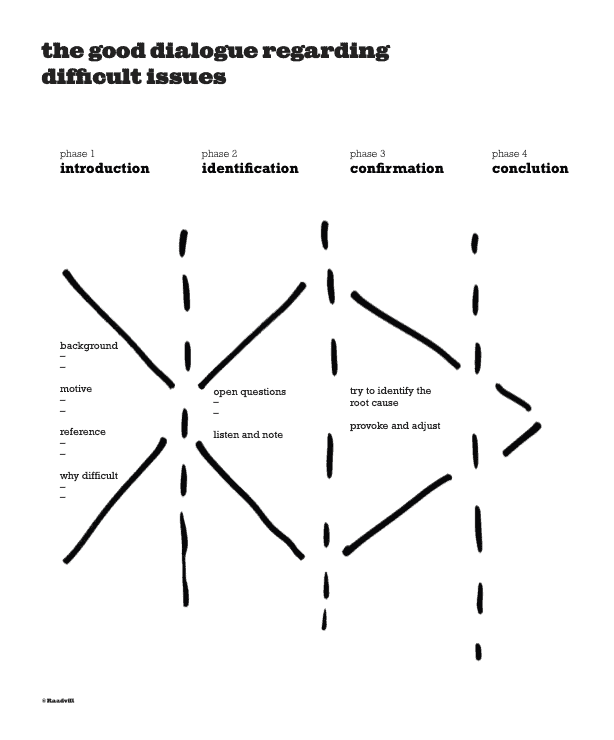
Introduction call

Point-by-point setup for starting a challenging conversation

The good conversation about difficult relationships

With employees who deliver slightly below expectations | case

1 : 1 evaluation and guidance

Using evaluation as a basis for precise guidance

Presentation technique

Create awareness and get others to listen to your message

How to order

Get others to deliver what you want

Striving towards the vision and living the values is first and foremost very effective. It is important to understand the significance of everyone having a common understanding of what the "mission" (vision) is. When the mission is translated into ambitions or objectives in the various interfaces, it is these that we then use to determine goals in the various underlying units such as departments or teams. Properly used, vision and values can create a common basis of agreement to build a clear corporate culture around

The Fariseer model

How do we ensure that the choices we make point towards the vision

The narrow path

How to use the values to achieve the vision

The success models

Building a lasting winning culture

Total model for management

What is leadership about

Teamkontrakt

The team contract is an effective tool for achieving ambitions. The contract is created by the team as a whole and is based on an “assignment” or an overarching task. The team then decides on an ambition and simultaneously asks and answers the questions; “Which activities must happen” and “which activities must not happen”. Close follow-up of the contract is crucial to success.

Constructive Feedback

This is a general, thematic course on what most kinds of feedback have in common. It helps us understand how we and others react to different kinds of feedback, given in different settings, so that we succeed in fitting the message to the person and the situation.

Effective teams

What's important for building well-functioning teams

From time to time, most people need good and precise feedback to stimulate their own development. When we give feedback, it is based directly or indirectly on evaluations we have made. That's why it's fundamentally important that the evaluation focuses on essential matters and that it's open. It is also important that we master some techniques or tools that make the feedback clear and understandable so that it can influence the behavior of the recipient in the right direction.

Constructive Feedback

This is a general, thematic course on what most kinds of feedback have in common. It helps us understand how we and others react to different kinds of feedback, given in different settings, so that we succeed in fitting the message to the person and the situation.

Questioning technique

How to ask for better answers

The 3 P's

Precise communication with low risk

Confirmation & conclusion

Method to ensure common understanding in order to make the right decision

1 : 1 evaluation and guidance

Using evaluation as a basis for precise guidance

Confrontation technique

Put an end to unwanted behavior

Recognition

Increase motivation with the right recognition

Guidance during instruction

Use of instruction to increase proficiency and compliance

Principles for guidance

Describes the most important activities in the guidance work

Evaluation

"Provide feedback that is useful and precise"

Continuous development

How to get a little better day by day

Transformation

How to achieve rapid compliance with new measures

What should we change?

Be aware of what we want to improve while taking little risk

The success models

Building a lasting winning culture

Skroll til toppen