

Target matrix
Schematic layout of the connection between goals and plan
Most people share the experience of having too little time to complete all their work tasks. And it's not just the work tasks either, but colleagues, customers and others who make demands on your time. Time is an absolute quantity and there's no more of it. Spending the majority of your time on the things that provide the greatest benefit is the key to better coping and increased well-being.

It's a common misconception that "my job" is the same as "my tasks". As employees and managers, we have a role that extends far beyond our defined tasks alone. We must all collaborate with others, develop ourselves and our work, and deliver results that are adapted to constantly changing requirements and challenges. Not least, we must be credible and good representatives of the company we work for.


Meetings as a form of work are perhaps the most overrated activity that takes place in organizations; overrated in terms of time spent and in terms of usefulness. It's probably all too easy to call a meeting without clear objectives or a good enough plan and still get full participation. On the other hand, it's easy to change less effective meetings into good meetings that use less time and deliver more value.


It's easy to get caught up in our own habits and work routines without asking ourselves whether these are still the right ones. Everything new hurts at first, and it's a common defense mechanism to say that this has been tried, but to no avail (and it's not my fault...). It takes time to incorporate new ways of working, and we don't get much benefit until we've become good at the new thing. When we're going to try something new, it's important that we've analyzed and know that this new approach will have a big effect.


Difficulties at home can easily lead to other matters being lost sight of. This is understandable, but at the same time it's important that the focus returns to the job after a while. Difficulties on one front do not diminish if we create difficulties on several other fronts at the same time; on the contrary, a "multi-front war" can quickly create a generally difficult life situation in which it is difficult to keep track of what is the cause and what is the effect.


It's a trap to think that I have to be motivated to show great commitment. On the contrary, working and participating with a high level of commitment is what produces results and mastery and thus creates the conditions for motivation. Lack of engagement over time must be addressed sooner rather than later, both for the sake of the person concerned, but also because a lack of engagement almost always leads to under-performance that affects everyone.
"Claiming your place" is often a good trait or attitude. Sometimes it becomes too much of a good thing and the person in question steals others' opportunity to make themselves legitimately noticed. Then someone takes up too much space and needs to be corrected. Making the person in question aware of the situation can be one contribution. Practicing becoming a better listener is always a great help. Sometimes it's deeper and part of the personality


A quibbler can be described as a person who can hardly ever admit their own mistakes or accept feedback; they are "always right". Perhaps worst of all, there is no distinction between big and small, important and unimportant; disagreements and keeping them alive may seem to be the main motivation. These tendencies are often rooted in personality, but it is by no means impossible to help them and make life easier for us around them.


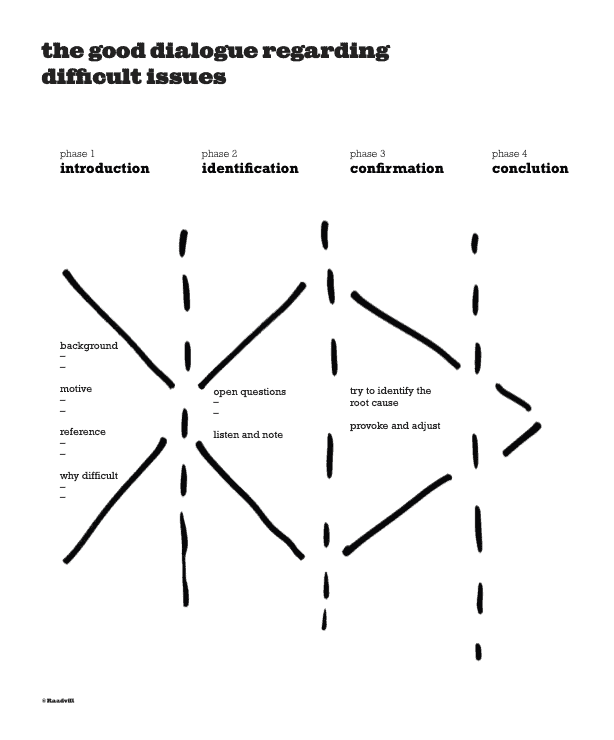
It can be challenging to keep an open mind and look for good solutions when a situation has arisen where you feel it's important to say this; it's not my fault! However, the most important thing is to move on and find good solutions, whether it's one or the other person who is most responsible for the unfortunate thing that has happened. And that's when it can be good to sort things out and come to an agreement about where we are and where we're going.

When a problem has been solved and the manager and employee agree on the way forward, it's easy to feel happy and uplifted; motivation is high and the plan is clear. Then comes everyday life, and you have to work patiently to maintain what has been improved. Old habits die hard, and we often need close follow-up and clear orders to stay on course and keep the momentum going.

The purpose of follow-up must always be to help the employee develop and cope better in their job. This is a major and important task that is inextricably linked to the long-term perspective of the company's development and ability to survive. Most people will benefit greatly from mastering simple and good questioning techniques. Appraisals are based on the same principles and should be structured in a way that makes it easy to provide the right feedback in relation to goals and plans.

Many of us work best under pressure simply because we are then forced to prioritize. Laying a good foundation for rapid compliance and checking that things are done the way we want is essential. At the same time, we need to understand what it takes to create compliance, which is where most people have a lot to work with. Giving clear feedback on what deserves to be recognized and behaviors we don't want to continue are important tools for creating progress. Even changing a company culture doesn't have to take that long

We often perceive ourselves as easy to understand and believe we give clear and correct messages. Evaluating hundreds of leaders over a long period of time shows that there doesn't have to be a great correlation between how we perceive ourselves and how others perceive us. Sometimes some people appear to be really difficult and impossible, and with good reason. However, almost all of them want to succeed and can do so with good help. It doesn't always have to take so long if the manager doesn't get stuck in their own external focus.
"I've said this a thousand times already...". "The info is in the email you received..." "This was discussed at the last info meeting you attended..."
There are many obvious reasons why not everyone understands "what has been said". The most important reason is that the person delivering the message does not check what people have actually understood or taken on board. We're probably not as clear as we like to think, and we do little to create good arenas for rapid perception and understanding. Open and correct questions can quickly clarify what is understood. It is then possible to challenge the extremes of understanding and find where consensus exists. This is how you can reach everyone

Sometimes it can be right to say that something is difficult or problematic. It says something about the dimension and the need to prioritize clearly. For many reasons, problematic behavior should not last long. It should be stopped and replaced with better behavior in line with the company's values and ethical guidelines. To change behavior for the better, we also need to be clear about what kind of behavior we expect

Implementing unpopular measures challenges the very role of leadership and our understanding of what it takes to maintain a healthy organization. If, as a leader, you also disagree with the management above you, and everyone knows your point of view, it is even more challenging. Knowing what it takes to succeed as a leader is a great help. Being confident about what you want to achieve as a leader and managing to get the right references in the situation is often crucial to the outcome.


None of us get through life without having made serious misjudgments. A natural reaction is to keep this hidden as best we can and for as long as possible to mitigate the effects. Such a strategy can be extremely risky because most things tend to happen overnight, and at least when we expect them to. Hiding material issues without addressing them can have serious consequences for respect, trust, reputation and financial performance. There's a simple way to settle the score

Underperforming over time is a common challenge for ourselves and the business and needs to be addressed before it becomes a problem. If it has already become a problem, it is even more urgent to change direction. There are often complex reasons why we fail to meet expectations, and there is a great need for different or varied approaches to turn performance around.
When people say something like that, it's either deliberately strategic (they don't want to do anything more or better), or they actually believe that they can't do anything more or better. Either way, such a stance is unfortunate for the person saying it and for the employer if it is maintained over time. Clear goals, good plans and close follow-up from the manager are often a good recipe. In the 1:1 arena that is created, there is ample opportunity to address other related topics
It's tempting to believe that motivation is the prerequisite for good performance and good results. Motivation is a handsome but unfaithful servant when the situation calls for hard work and perseverance without particular results there and then. To succeed, we need more than motivation alone, and patience and hard work often lead to the results we strive for. Then comes satisfaction and motivation as we succeed
Far too many information meetings could just as easily not have been held and the information made available in other, more effective ways. The most important reason why many information meetings are not particularly useful is that no one checks what the meeting participants have understood of what has been reviewed. Another reason for low value is that the presentation is not based on the rules of good presentation technique, but rather is just that: a "review". There are relatively simple ways, albeit perhaps slightly different, to increase the benefit of info meetings

A real conflict is a long-standing disagreement that has degenerated in such a way that strong negative emotions dominate over the actual issue or cause of the disagreement. It's not always enough to simply remove the cause. So many provocative things have happened or been said along the way that are perceived as hurtful or offensive that it is necessary to use caution and, above all, the right tools to end the conflict.
Trust is a function of several things, but it's not something we can demand that others have for us unless we have earned it. People who show others respect often receive trust in return. One way to show respect in practice is to ask good questions and listen to the answers given to find the best basis for decisions. Then we must act clearly and predictably and live up to what we ourselves consider important and right. In any case, we must always be able to present the results of our work

Typically, we don't spend enough time talking about the value of being good or among the best in our own way and within our areas of opportunity. If we skip this, it's easy to create resistance to the work that needs to be done throughout the company to be more successful. There's little point in striving if we don't get recognition when we get it right. So we need to understand some important connections and park misconceptions
There doesn't have to be a contradiction between taking care of a "buddy relationship" and being a manager for the same "buddy". But it can be demanding, and it can be easy to make mistakes. Buddy relationships are naturally built on equality in the relationship, while the relationship between manager and employee is not. The focus in the manager/employee relationship should always be job-related, while in a buddy relationship it's the social talk and interest in each other's life situations that dominate and take attention. Balancing these different considerations against each other is crucial to how well both relationships develop.
Deviations can occur for many reasons and vary in type and scope. Deviations in the form of undesirable behavior are technically easy to terminate correctly. However, undesirable behavior is something that many managers are reluctant to deal with. Other deviations are often caused by unclear orders or the manager not checking what the employee actually understands he is supposed to do. Deviations can also be due to a lack of motivation or willingness to comply, in which case they require a completely different approach to the situation described above.
Complying with something is completely different from merely understanding it. Understanding doesn't necessarily lead to compliance, and this is at least and very often the case when it comes to complying with the company's values or code of conduct. Without practicing how to use the values as a reference in different situations, the result is that values and ethical guidelines are something that is written on the website or displayed at events. Companies whose culture is based on shared adherence to values often have high job satisfaction and good results over time.
